Established 1870 Minonk, Illinois
This article was prepared by Brittany Baumann as a requirement for a history class as a sophomore at the Mary Institute St. Louis Country Day School
in 2002.
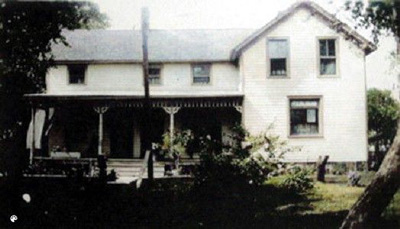
The Baumann Family Farm
The Baumann family farm originated in Minonk, Illinois in 1857 when
Amos Babcock bought the 160-acre farm from the U.S. government.
Thirteen years later, Lammert Baumann, a German native, arrived in
Minonk and bought the 160 acres from Babcock. For the next 110 years,
the three generations of the Baumann family occupied the farm through
times of both prosperity and depression. Life on the farm consistently
changed during each generation in response to the outside American
world. The American economy and technology created changes in the
production, landscape, and daily life through four generations of the
Baumann farm.
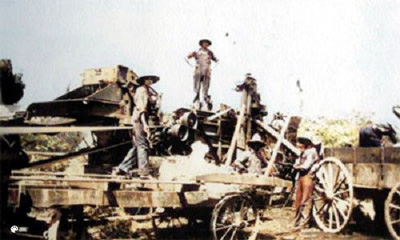
Lammert Baumann and his wife, Antje, owned and cultivated the Baumann
farm from 1870 to 1904. They farmed corn, oats, alfalfa, and clover.
Animals included horses, chickens, hogs, ducks, geese, and milk and
beef cows. Income was from selling corn, oats, meat, and milk. Hay
(from clover and alfalfa) was needed to feed the horses and, in the
winter, the cattle as well. The labor for farming needed manual and
horse labor. A horse and wooden plow was used to plow the land.
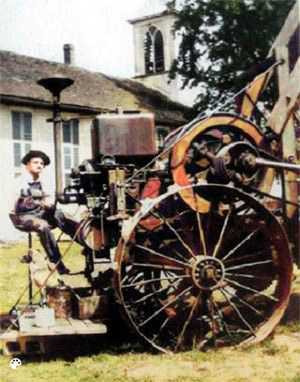
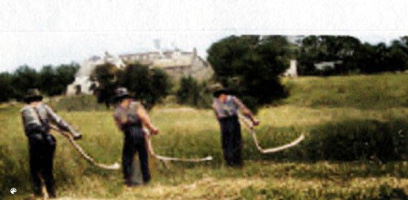
To harvest oats, farmers used a scythe to harvest corn, they used a corn-husking peg
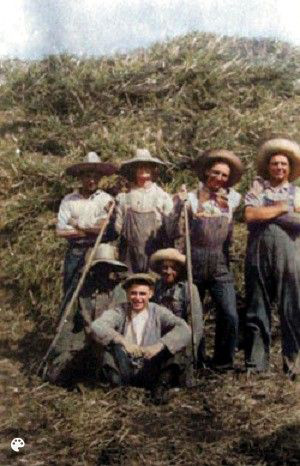
to shuck the corn. By the end of the generation, Lammert began using a
primitive threshing machine to harvest oats shown above. They would
collect the corn and oats manually by throwing it into wagons with
wooden wheels. The corn was stored in the corncrib to dry. Animal
manure was used as fertilizer. There were no insecticides or hybrid
corn, which is produced by crossing different varieties of corn.
Farming and production was a tedious and strenuous task with a
comparatively small output. During this generation, the amount of crop
produced per acre remained the same, as did the size of most farms,
according to Figures A and B.
Since the economy was already becoming commercially based, the percent
of farmers in the labor force was steadily declining according to
Figure C.
When
Lammert arrived at his Illinois farm of 160 acres (a quarter of a
square mile), the land was fertile but was still at times swampy, for
the mole ditchers drained the land for only one season and would then
collapse. Mole ditchers were hollow tunnels under the land that drained
water to nearby creeks.
Around the 1880's, Lammert tiled the hollow tunnels. These clay tiles
permanently drained the land because they lasted for decades. The
prairie grass was mostly burned down by the early native Indians and
there were very few trees and creeks. Thus, Lammert planted many trees on his farm. There
were many wild animals: deer, wolves, prairie chickens, and
rattlesnakes. To kill these varmints, Lammert and other farmers formed
groups for hunting.
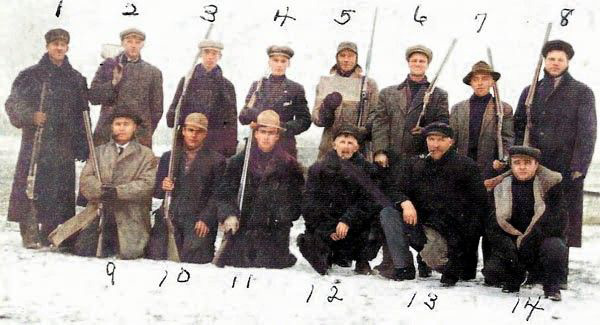
Back row, left to right; John Kalkwarf, John Ruestman, John Baumann,
Uffe Kettwich, Eilert Kettwich, David Kalkwarf, Waite Prickert, Murry
Front row, left to right; George Kettwich, John Kettwich, Carl Kettwich, Henry Lieder, Frank Baumann, Sr., Henry Kettwich
During
his ownership, Lammert completed the construction of a farmhouse, a
windmill, two barns, a tool shed, a hog house, a coalhouse, a brooder
lighthouse for the incubation of chicks, a corncrib, and a summer
kitchen. The summer kitchen was used for cooking and canning during the
summer so the heat would not affect the house. The barn was a shelter
for the cattle and also stored hay. He planted orchards of apples,
pears, grapes, apricots, plums, cherries, raspberries, and strawberries
as well as a vegetable garden. His family could create their own secure
food source.
The five-acre pasture was surrounded by barbed wire after about a
decade of his ownership. The entire farm was gradually surrounded by a
long barbed wire fence. The land and farmstead became fully cultivated
and developed.
The
first generation Baumann's lived a strenuous life with no electricity
or indoor plumbing and long labor hours. All family members awoke at 5
a.m. to begin the numerous farm tasks, like milking cows, feeding
animals, and collecting chicken eggs. During the growing and harvest
season, the men worked all day in the fields.
The
women usually stayed in the kitchen, cooking meals and canning. The
children attended German school during the day. At 5 p.m., the farmers
followed the same routine as the early morning routine. In the
farmhouse, they had kerosene lamps for light and used coal and corncobs
to the heat the house. For drinking water, they used the water that ran
off the roof into a cistern. The windmill pumped water to a tank for
the cattle, hogs, and horses. When working in the fields, the farmers
would bring barrels and jugs of water to drink. Through the entire
year, the family had to use an outhouse toilet. Lammert and Antje had
nine children, who provided extra help on the farm. They spoke only
German and were clearly extremely hard workers.