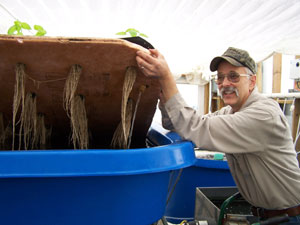
 Myles Harsten shows the roots of the basil he grows in fish water at his aqua farm in Flanagan.
A
new fish farm is being spawned 10 miles east of Minonk in
Flanagan. However, this is not your ordinary fish farm.
Myles Harsten, owner and operator of Aqua Ranch, is betting that there
is a market for organically grown fish and basil plants. That
made sound like an odd combination but Harsten has developed a business
model in which these two disparate products have a symbiotic
relationship that results in synergies not possible if they were grown
apart from each other. The process is called aquaponics and is
the combination of aquaculture (the raising of fish) and hydroponics
(vegetables grown without soil).
The process starts in the
hatchery building when every 2 weeks Harsten harvests the eggs from
talapia, an African cichlid, which is becoming one of the more popular
fish entrees in American restaurants. In fact, Harsten said that
talapia is the second most consumed fish behind catfish which is far
and away the most popular fish for American consumers.
The
female talapia lays the eggs in a large PVC tube which is fertilized by
the male. Then the female scoops up the eggs and keeps them in
her mouth where they incubate. Every 2 weeks the eggs are removed from
the female's mouth before they hatch and are placed in a fry tank where
the eggs are eventually hatched.
The newly hatched fish
called fingerlings are placed in a 300 gallon tank for 3 months.
Next they are removed to the building next door and placed in 300
gallon tanks for 24 weeks at which time they will be ready for market.
Each of the 12 tanks contain anywhere from 800 to 1000 talapia. The
whole process from hatching to the market takes anywhere from 10 to 12
months. But this is not the main product of this venture.
This last stage is where the symbiotic relationship between fish and
basil takes place. The waste water from the fish tanks is
constantly filtered through a process that removes the particulate from
the fish water and also degassifies the water. The filtered water
flows to the next building which contain several 150 foot long concrete
tanks filled with floating platforms of basil plants growing in little
pots placed in cococoir, a special type of growing medium.
Studies have shown that basil grown in aquaculture water have 3 times
more root development and 35-40% more production. And the quality is
superior.
The fish water is naturally high in nutrients and
nitrates. Excessively high nutrient levels in an aquaculture
system can easily become toxic to fish. The basil plant roots thrive on
the nutrients from fish water and in turn remove the excess of
nutrients from the water. The refreshed fish water is then
recycled back to the fish tanks where the whole process is
repeated. This symbiotic relationship between the fish and the
basil results in fresh water for the fish and fertilizer for the basil
plants. Harsten said that this process results in only a 2% loss
of water per week whereas a normal hydroponic system results in a loss
of 25% per day!
Harsten has already made plans with a
large midwest grocery chain to market the basil plants. It takes
about 2 months to raise the basil to maturity which will be sold as
whole plants. Growth rate of the plants are determined by the
amount of foood fed to the fish. He plans to market the talapia
directly to consumers in order to be cost effective. 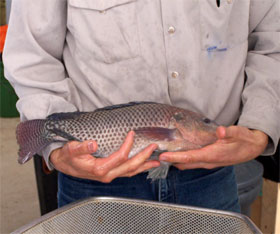
At the right Harsten holds a 3 lb. talapia ready for market.
Harsten said that the fish he will be selling will not have the fishy
odor that most people dislike because the fish are raised in filtered
water free from algae. Eventually, he will be one of the
few producers who can claim their fish is organically grown.
Harsten can claim that the fish are naturally grown free of hormones
and other supplements that most commercial fish farms use.
To view more photos of the aqua farm, click here.
For those who are interested in Miles Harsten's fish and basil, he can be contacted at 309-208-5230 or email at myles@aquaranch.com.